
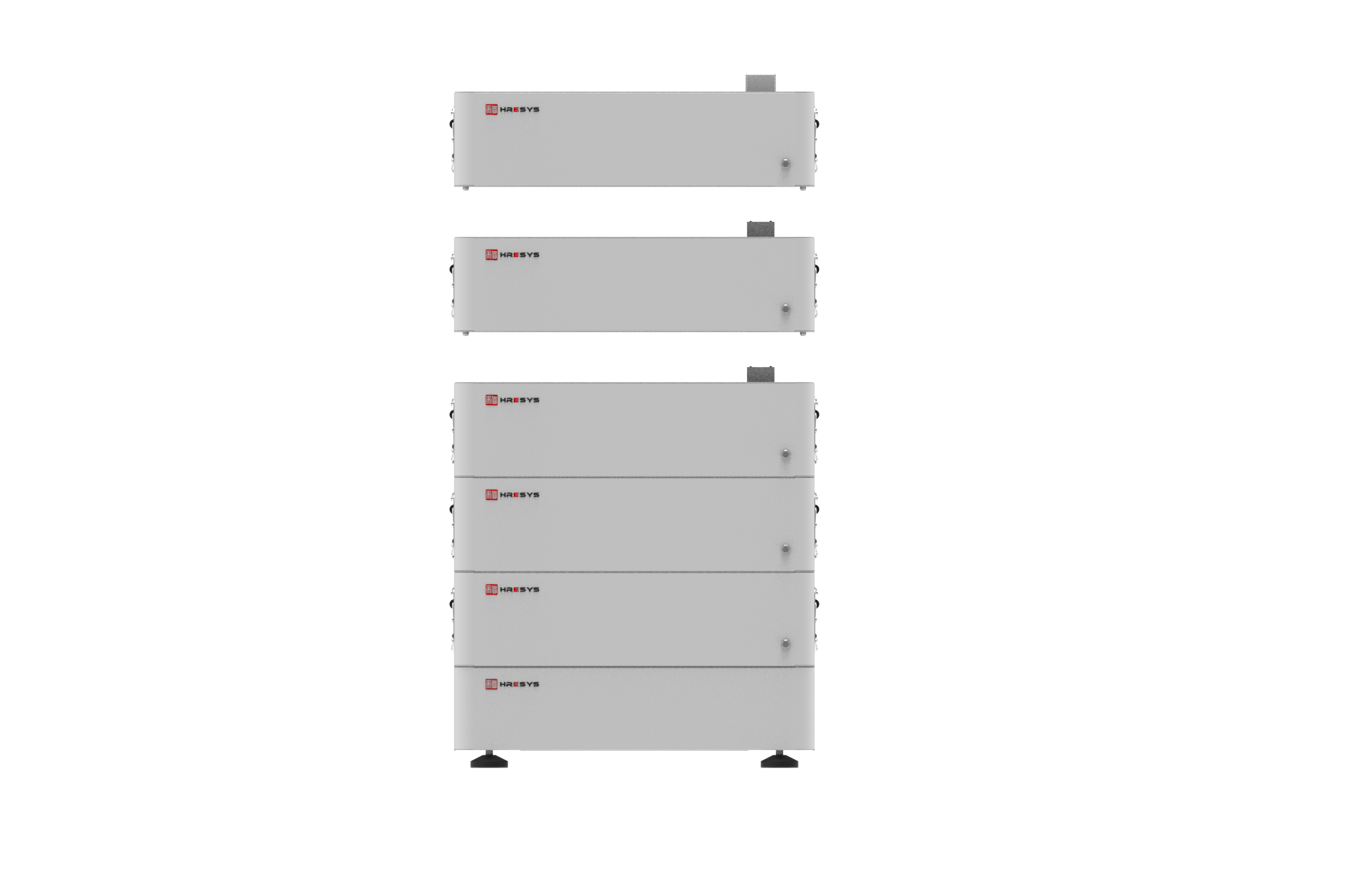
HRESYS Manufacturer Household Energy Storage Battery System
| Feature | Specification |
|---|---|
| Nominal Voltage | 48V |
| Nominal Capacity | 100Ah |
| Energy Capacity | 4.8kWh-24kWh |
| Dimensions | Various (refer to specific models) |
| Weight | 18-81 kg (depending on model) |
Common Product Specifications
| Model No. | Nominal Voltage (V) | Nominal Capacity (Ah) | Dimension (mm) | Weight (±2kg) |
|---|---|---|---|---|
| VHR TL3650LFP | 35.2 | 50 | 500 x 250 x 133 | 19 |
| VHR TL36100LFP | 35.2 | 100 | 517 x 314 x 220 | 34 |
| VHR TL4830LFP | 48.0 | 30 | 442 x 330 x 133 | 18 |
| VHR TL4850LFP | 48.0 | 50 | 440 x 390 x 133 | 25 |
| VHR TL4880LFP-4U | 48.0 | 80 | 440 x 440 x 176 | 42 |
| VHR TL48100LFP-3U | 48.0 | 100 | 440 x 440 x 133 | 43 |
| VHR TL48150LFP | 48.0 | 150 | 440 x 480 x 222 | 66 |
| VHR TL48200LFP | 48.0 | 200 | 440 x 550 x 222 | 81 |
| VHR TL51100LFP-3U | 51.2 | 100 | 440 x 440 x 133 | 46 |
| VHR TL51150LFP | 51.2 | 150 | 440 x 480 x 222 | 68 |
Product Manufacturing Process
The manufacturing process of HRESYS household energy storage batteries involves several key stages to ensure high quality and reliability:
- Material Selection: High-quality lithium iron phosphate (LFP) materials are selected for their superior energy density and safety features.
- Cell Assembly: The LFP cells are assembled in a controlled environment to maintain consistency and performance.
- Battery Module Integration: The cells are integrated into modules, with each module undergoing rigorous testing for capacity, resistance, and voltage.
- BMS Installation: An advanced Battery Management System (BMS) is installed to monitor and manage the battery’s performance, temperature, and safety features.
- Quality Control: Each battery module is subjected to a series of quality control tests to ensure they meet industry standards and HRESYS's stringent quality requirements.
- Packaging and Shipment: After passing quality control, the batteries are securely packaged and prepared for shipment to customers.
Product Application Scenarios
HRESYS household energy storage batteries are highly versatile and can be applied in various scenarios:
- Residential Solar Systems: These batteries can store excess energy generated from residential solar panels, providing power during nighttime or cloudy days.
- Emergency Backup: In regions prone to power outages, these batteries offer a reliable backup power source to maintain essential home functions.
- Off-Grid Living: For homes in remote locations without grid access, these batteries enable energy independence and sustainability.
- Grid Stabilization: By decentralizing energy production and storage, household batteries can contribute to overall grid stability and reduce the risk of blackouts.
Product After-Sales Service
HRESYS provides comprehensive after-sales service to ensure customer satisfaction:
- Technical Support: 24/7 technical support for troubleshooting and product inquiries.
- Warranty: Standard warranty period provided with options for extended warranty plans.
- Replacement Service: Efficient handling of product replacements due to manufacturing defects.
- Maintenance: Periodic maintenance services to extend the lifespan of the batteries.
Product Transportation
HRESYS follows stringent transportation protocols to ensure product safety during transit:
- Secure Packaging: Batteries are packed in secure, impact-resistant cases.
- Compliance: Adherence to international transportation regulations for hazardous materials.
- Tracking: Real-time tracking provided for shipments to ensure timely delivery.
Product Advantages
- Long cycle life and low maintenance requirements.
- High energy density and safety with LFP technology.
- Modular design for easy installation and scalability.
- Advanced BMS for optimal performance and safety monitoring.
- Supports parallel connection to increase capacity.
- Bluetooth connection and APP monitoring for user convenience.
Product FAQ
- Q: What is the expected lifespan of the HRESYS household energy storage battery?
A: The expected lifespan of our LFP batteries is approximately 10-15 years, depending on usage patterns and maintenance. - Q: Can the battery system be expanded if my energy needs increase?
A: Yes, our modular design allows for easy expansion by adding more battery modules in parallel to increase capacity. - Q: Are HRESYS batteries safe for indoor installation?
A: Absolutely, our batteries are designed with multiple safety features, including an advanced BMS, to ensure safe indoor installation. - Q: What maintenance is required for these battery systems?
A: Our LFP battery systems are low maintenance, requiring periodic checks to monitor performance and ensure optimal operation. - Q: How does the smart BMS improve battery performance?
A: The smart BMS monitors the battery's voltage, temperature, and charge/discharge rates, ensuring optimal performance and safety. - Q: Can these batteries be used with any solar panel system?
A: Yes, our batteries are compatible with most solar panel systems, making them a versatile choice for residential solar energy storage. - Q: What kind of technical support does HRESYS offer post-installation?
A: We offer 24/7 technical support, assisting with any operational queries or troubleshooting needs. - Q: Is there a warranty for the HRESYS household energy storage battery?
A: Yes, we provide a standard warranty period with options for extended coverage depending on customer requirements. - Q: How does the Bluetooth and APP monitoring feature work?
A: The Bluetooth connection allows the battery to be linked to our monitoring app, enabling real-time check of battery status and performance metrics. - Q: What are the environmental benefits of using HRESYS batteries?
A: Our batteries support renewable energy storage, reducing reliance on fossil fuels, and helping lower greenhouse gas emissions.
Product Hot Topics
- Q: How does HRESYS differentiate its household energy storage batteries from other manufacturers?
A: HRESYS stands out by utilizing high-performance lithium iron phosphate (LFP) technology, which offers superior safety and longevity compared to other lithium-ion types. Our focus on integrating smart BMS further ensures optimal performance and user-friendly operation. Additionally, our commitment to quality, rigorous testing, and comprehensive after-sales support positions us as a reliable manufacturer in the household energy storage battery market. - Q: What are the key advantages of using lithium iron phosphate (LFP) batteries in household energy storage?
A: Lithium iron phosphate (LFP) batteries are favored for their high thermal stability, safety, and long cycle life. Compared to other lithium-ion batteries, LFP batteries are less prone to overheating and thermal runaway, making them ideal for residential use. They also offer a longer lifespan and require minimal maintenance, providing homeowners with a reliable and cost-effective energy storage solution. As a manufacturer, we ensure that our LFP batteries meet the highest standards of safety and efficiency. - Q: In what ways do household energy storage batteries contribute to energy independence?
A: Household energy storage batteries allow homeowners to store excess energy generated from renewable sources like solar panels. This stored energy can be used during times when solar production is low or during power outages, reducing dependence on the grid. By providing a consistent and self-sufficient energy supply, these batteries enable homeowners to achieve greater energy independence. Our role as a manufacturer is to ensure these systems are efficient, safe, and easy to integrate into residential setups. - Q: How do government incentives impact the adoption of household energy storage batteries?
A: Government incentives such as tax credits, rebates, and feed-in tariffs can significantly reduce the initial cost of installing household energy storage systems. These financial incentives make the technology more accessible to homeowners, encouraging wider adoption. As a manufacturer, we stay informed about these incentives to help our customers maximize their investment in our energy storage solutions. - Q: What factors should be considered when choosing a household energy storage battery system?
A: Key factors include the battery's energy capacity, lifespan, maintenance needs, safety features, and compatibility with existing renewable energy systems. Additionally, homeowners should consider the manufacturer's reputation, warranty terms, and after-sales support. At HRESYS, we emphasize these aspects to provide our customers with reliable and efficient household energy storage solutions. - Q: Can household energy storage batteries help in reducing electricity bills?
A: Yes, household energy storage batteries can lead to significant cost savings. By storing energy during off-peak hours when electricity rates are lower and using it during peak hours, homeowners can reduce their electricity bills. Moreover, storing excess renewable energy for later use further decreases reliance on grid power, enhancing savings. As a manufacturer, we design our batteries to optimize these benefits for our customers. - Q: What role does the smart Battery Management System (BMS) play in household energy storage batteries?
A: The smart BMS is crucial for monitoring and managing the battery's performance. It oversees charging and discharging cycles, ensures temperature stability, prevents overcharging, and enhances overall safety. This system also provides real-time data through Bluetooth and app connectivity, allowing users to monitor their battery's status easily. Our focus as a manufacturer is to integrate advanced BMS technology into our products to ensure reliability and safety. - Q: How does modular design benefit household energy storage systems?
A: A modular design allows for scalability, making it easy to expand the system as energy needs grow. Homeowners can start with a smaller setup and add more battery modules over time. This flexibility ensures that the system can adapt to changing energy requirements without significant upfront costs. As a manufacturer, we prioritize modularity in our designs to offer flexible and future-proof solutions to our customers. - Q: What environmental benefits can be achieved by using household energy storage batteries?
A: Household energy storage batteries facilitate the use of renewable energy by storing excess power generated from sources like solar panels. This reduces reliance on fossil fuels, leading to lower greenhouse gas emissions and a smaller carbon footprint. By promoting renewable energy adoption, these batteries play a crucial role in achieving sustainability goals. As a manufacturer, HRESYS is committed to providing environmentally friendly energy storage solutions. - Q: How do HRESYS household energy storage batteries support grid stability?
A: By decentralizing energy production and storage, household batteries can alleviate pressure on the grid, especially during peak demand periods. These batteries can supply power locally, reducing the risk of blackouts and enhancing overall grid stability. Our goal as a manufacturer is to develop batteries that not only serve individual households but also contribute positively to the broader energy infrastructure.
Image Description


 Privacy settings